
8. Song breakdowns
← Genre fusion · Guide contents · Next: Common pitfalls →
The ideas in the earlier chapters only become useful once I can hear them inside a whole track. These breakdowns keep the prompts, available controls and intermediate generations together so the reason for each decision does not disappear behind the final result.
Under the Asset Policy, final releases and covered source songs remain on their official Suno pages. I host only the unpublished intermediate audio that makes the change between stages easier to hear.
| Project | Core method | Media included |
|---|---|---|
| Foggy Hearts | Identity → Behaviour → Confidence | Workflow diagram and two intermediate Covers |
| Flowstate In Yellow | Anchor + Kinetic Engine → Assembly → Cohesion | Workflow diagram and four intermediate tracks |
| Pressure | Foundation → Vocabulary → Assembly → Cohesion | Workflow diagram and three intermediate tracks |
| Pass It On | Instrumental + vocal generation → Mashup → Cover → handoff | Intermediate audio and official final-release player |
Foggy Hearts
Section titled “Foggy Hearts”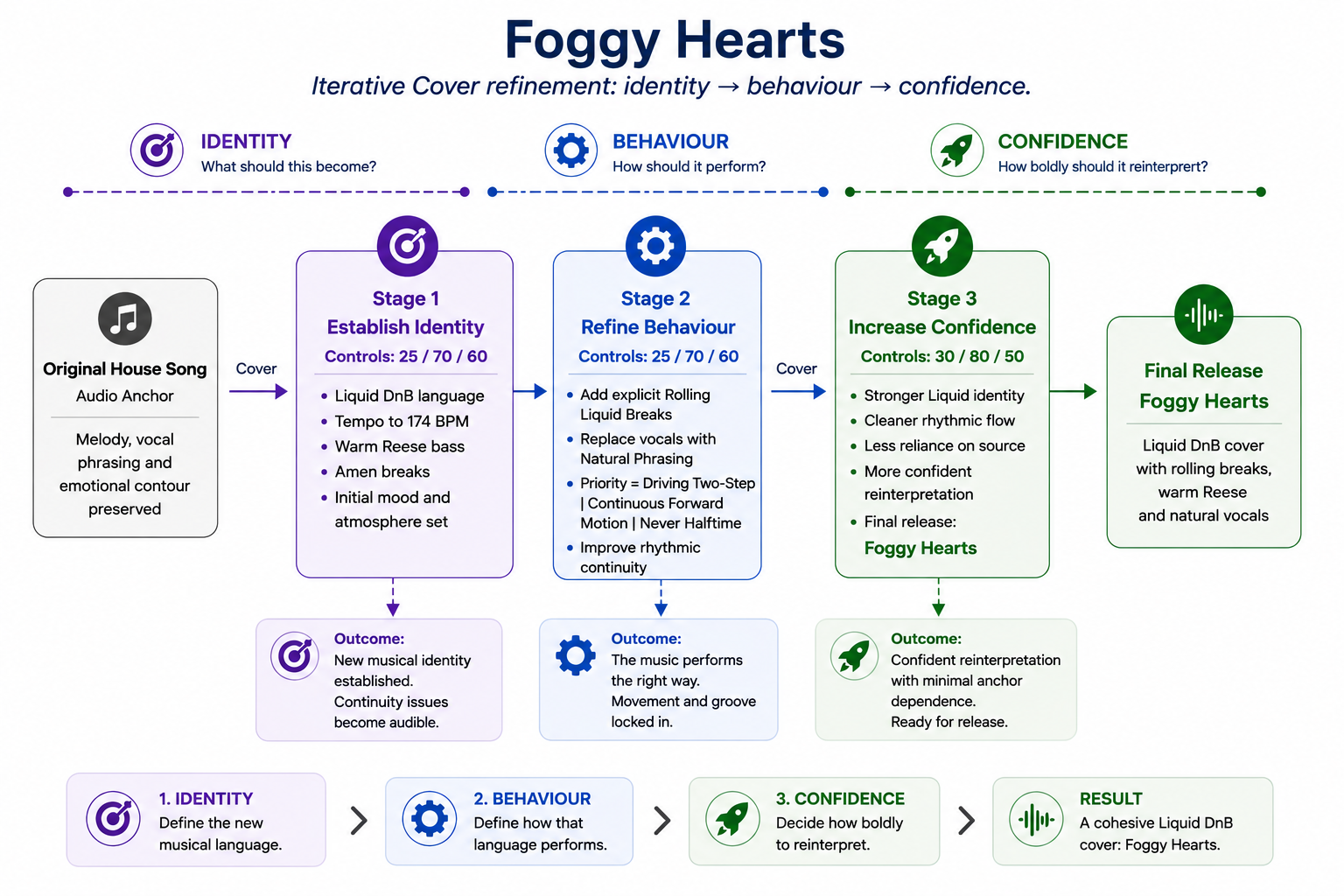
Foggy Hearts began as a clean, spacious Deep UK House song by Niri. The vocal was clear, the bass was behaved and there was enough room in the arrangement for me to push it towards Liquid Drum and Bass without losing the emotion that drew me to the original.
The first Cover reached the right genre, but the vocals sped up and became more synthetic, the drums felt too relaxed and the bass carried too much of the original House bounce. The next pass answered those things directly. I added one Rhythm field, then rewrote Vocal and Priority around natural phrasing and continuous full-time movement.
Once the Behaviour felt right, I kept the prompt unchanged and adjusted only the influence controls. That separated the project into three questions:
Identity — What should this become?Behaviour — How should it perform?Confidence — How much freedom should the model have?The Identity and Behaviour generations keep the controls at 25 / 70 / 60, so the effect of the prompt revision is easier to follow. The final release keeps the Behaviour prompt and moves only the controls to 30 / 80 / 50.
Explore the complete Foggy Hearts breakdown, including Niri’s original, both intermediate Covers, the final release and the exact prompt revisions.
Flowstate In Yellow
Section titled “Flowstate In Yellow”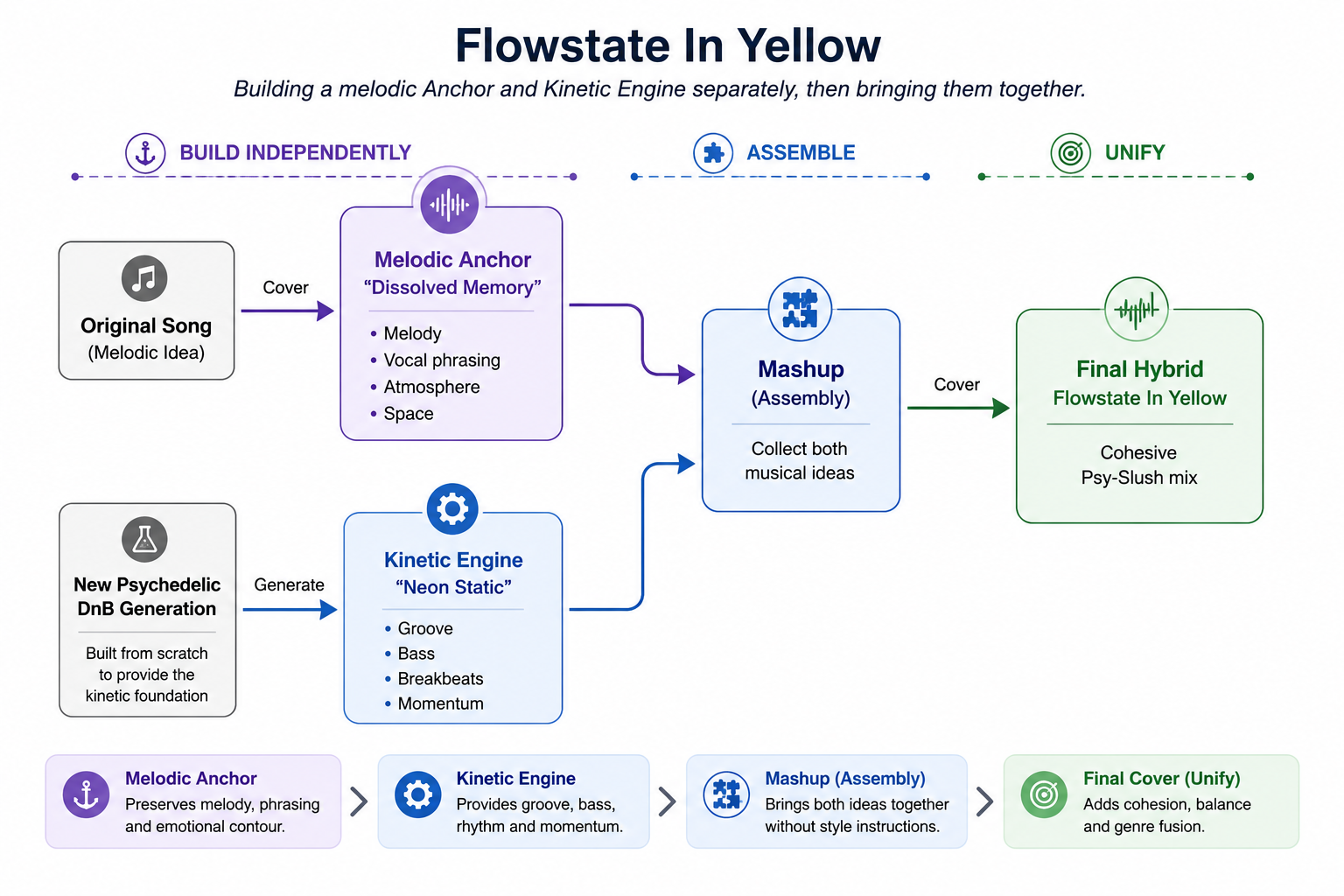
Flowstate In Yellow began with a Studio-made track by WryCrossfader. Its vocal melody caught me immediately. I preserved that melody in a spacious Slushwave Cover called Dissolved Memory, then generated the movement separately so the Anchor did not also have to drive the track.
The first Kinetic Engine, Neon Horizon, worked structurally but settled into a familiar Liquid Drum and Bass shape. I kept its genre, tempo and key fixed, then rewrote the performance language around instability, altered motion and psychedelic texture. That became Neon Static. Both versions are here because the contrast explains the revision better than the final prompt can on its own.
I combined Dissolved Memory and Neon Static without a style prompt. At that point I only wanted Mashup to gather their musical content. The final Cover had a different job: give that composite one Psychedelic Drum and Bass × Slushwave language. Listen to the finished Psyslush mix.
Explore the complete Flowstate In Yellow breakdown, including the Anchor, both Kinetic Engines, the Mashup, all four prompts and the final Cover.
Pressure
Section titled “Pressure”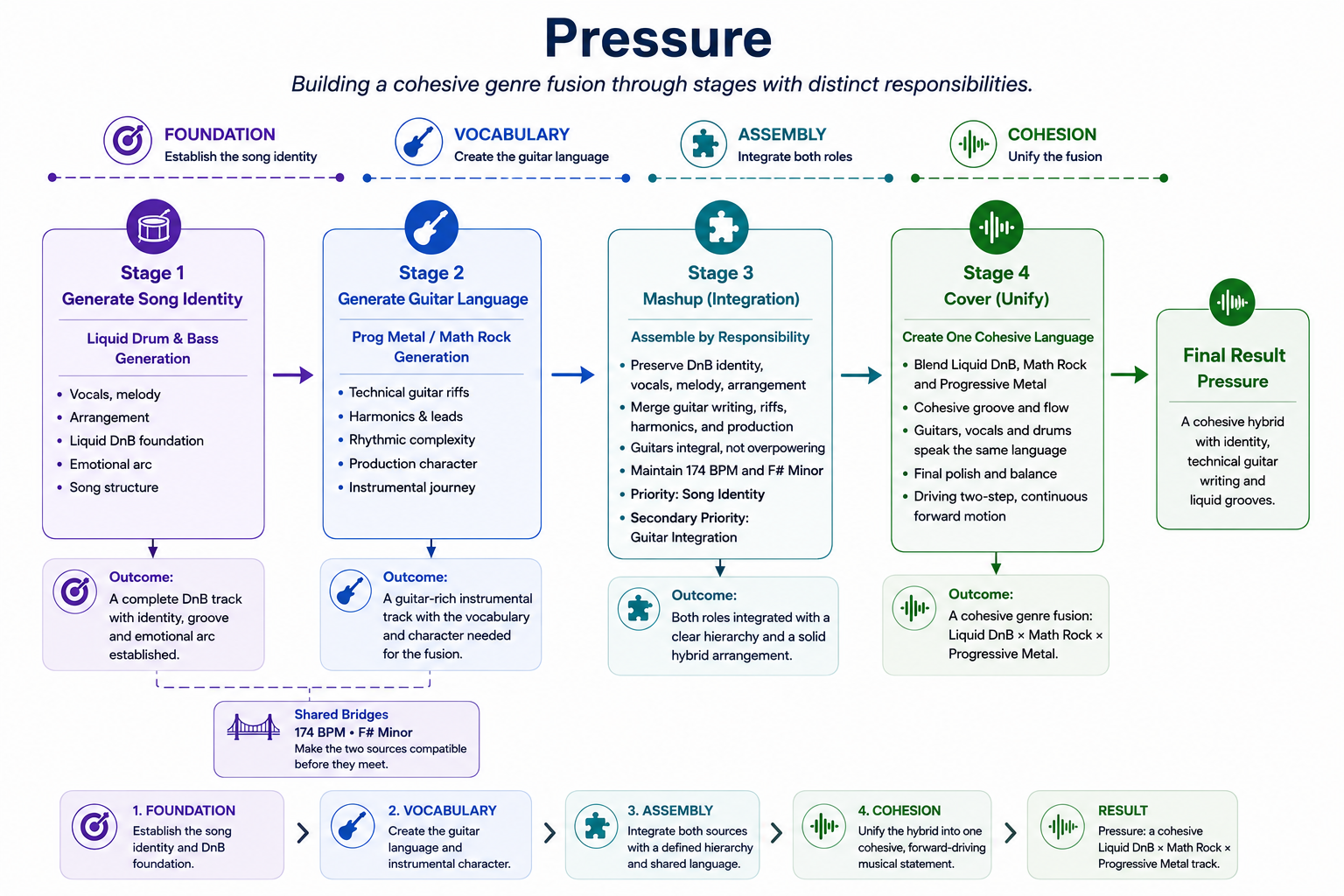
Pressure started with no finished source song. I wanted Liquid Drum and Bass, Math Rock and Progressive Metal together without the guitars swallowing the vocal song or the DnB becoming a backing layer. The first generation established the Foundation—vocal performance, melody, arrangement and emotional arc—while a separate Progressive Metal × Math Rock generation created the technical guitar Vocabulary.
I kept both sources at 174 BPM and F# Minor so they had a musical Bridge before they met. The Mashup then handled Assembly with an explicit hierarchy: preserve the DnB song identity first and integrate the guitar language second. Its controls were Weirdness 30%, Style Influence 76% and Audio Influence 50%.
The Mashup contained the right material, but I still wanted it to feel like one track. The final Cover handled that Cohesion with the three-genre prompt and Suno’s unchanged defaults—Weirdness 50%, Style Influence 50% and Audio Influence 25%. The earlier stages had already built and integrated the difficult parts, so this pass did not need another aggressive transformation.
Explore the complete Pressure breakdown, including both source generations, the Mashup audio, every prompt and the final Cover settings.
Pass It On
Section titled “Pass It On”Pass It On began with a Phrygian Dominant DnB idea and Dorian vocals, both centred on F#. I generated the instrumental and vocal tracks separately, combined them through Mashup without a style prompt or settings changes, then used Cover to bring them together.
The final prompt asked musical ideas to pass between elements and return transformed. Afterwards, I decided to turn that into a game of musical Gartic Phone and handed the track to Logia.
Explore the complete Pass It On breakdown, including all three style prompts, intermediate audio and the final release.
Planned breakdowns
Section titled “Planned breakdowns”| Project | Question to explore |
|---|---|
| Nostalgic Wonder | How do Chiptune, Liquid Drum and Bass and Spectral language form one semantic stack? |
| Neon Circuit Dreams | What changes when the same idea moves from Cover to Generate and loses its audio Anchor? |
I will add these when the prompts, links, intermediate media and my listening notes are complete enough to explain the actual decisions rather than reconstruct a tidy story afterwards.